

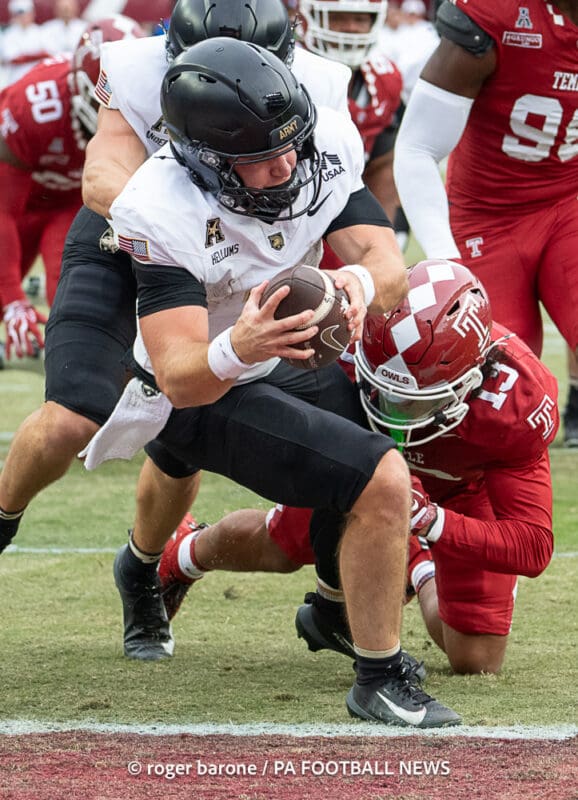
Temple’s growth finally shows in the finish against South Florida
Tagged under: News, Pennsylvania Colleges, pfn, Temple
Mike Livingston | October 6, 2026
Temple spent much of September talking about how close it was.
The Owls had stretches against Toledo when their offense looked capable of controlling a game. They had a fourth-quarter lead against Army. Players and coaches continued to point toward small mistakes, details and execution as the difference between what Temple believed it was becoming and its 1-3 record.
Saturday was the first time the progress came with proof.
Temple went into Tampa and knocked off previously unbeaten South Florida, 17-13, moving to 2-3 overall and 1-1 in American Conference play. More important than the record, the Owls finally handled the type of late-game situation that had beaten them in consecutive weeks.
That makes this week’s development less about one play and more about what Temple showed when things went wrong.
Sheppard is starting to look comfortable
Ajani Sheppard’s night could have unraveled in the third quarter.
With Temple driving into scoring position, Sheppard lost a fumble near the goal line. South Florida eventually took a 13-10 lead, leaving the Owls backed up at their own 4-yard line when they got another opportunity with 8:32 remaining.
Sheppard responded by directing a 96-yard touchdown drive and finishing it himself with a 34-yard run on third-and-seven.
It was another step in a progression offensive coordinator and quarterbacks coach Tyler Walker believes simply required opportunity.
“Just reps, time, reps,” Walker said. “You just got to play.”
Sheppard did not have many of those opportunities before arriving at Temple. Now, with Jaxon Smolik sidelined by a foot injury, consecutive starts have allowed him to see defenses in real time rather than through practice and film.
Sheppard said Monday that the biggest improvement has come with his eyes. His preparation has also expanded since the Toledo game to include visualizing the game plan before he takes the field.
Walker has seen the game begin to slow down for him as those repetitions accumulate. The USF game provided perhaps the clearest example yet. Sheppard wasn’t defined by the turnover; he was able to come back and execute when Temple needed another drive.
He finished with 179 total yards and accounted for both Temple touchdowns.
Temple’s depth is starting to show up
Sheppard wasn’t the only Owl forced into a larger role in Tampa.
Running back Sam Brown was unavailable, creating more work behind Keveun Mason. Hunter Smith responded with his most meaningful contribution of the season, including a 34-yard run during the second half.
Temple still rushed for 182 yards despite Brown’s absence.
That mattered for an offense whose identity has increasingly formed around the ground game. The Owls have not needed the same running back to carry the entire workload every week, and Sheppard’s mobility has added another element defenses must account for.
The same next-man-up mentality showed elsewhere. Temple has continued rotating bodies along the offensive line, while a defense that has dealt with its own injuries finally produced the late stop it had been searching for.
Against Toledo and Army, Temple had chances to protect late leads and couldn’t finish. Against USF, the defense forced a turnover on downs after Sheppard’s touchdown and survived one final possession to close the game.
That doesn’t erase the previous two losses. It does give the Owls something tangible to point toward when they talk about improvement.
Now Temple has to prove it travels week to week
The USF win changes the feeling around Temple more than it changes what still needs work.
The Owls remain below .500. Their passing game has yet to consistently complement one of the conference’s more productive rushing attacks, tackling remains an area Keeler wants improved and Smolik’s eventual return will give the coaching staff another decision to make at quarterback.
One finish also doesn’t automatically solve the late-game problems that appeared against Toledo and Army.
But Temple no longer has to explain what its growth is supposed to look like.
For one night in Tampa, the Owls showed it.
The next stage of their development begins Saturday against UConn: proving they can do it again.