

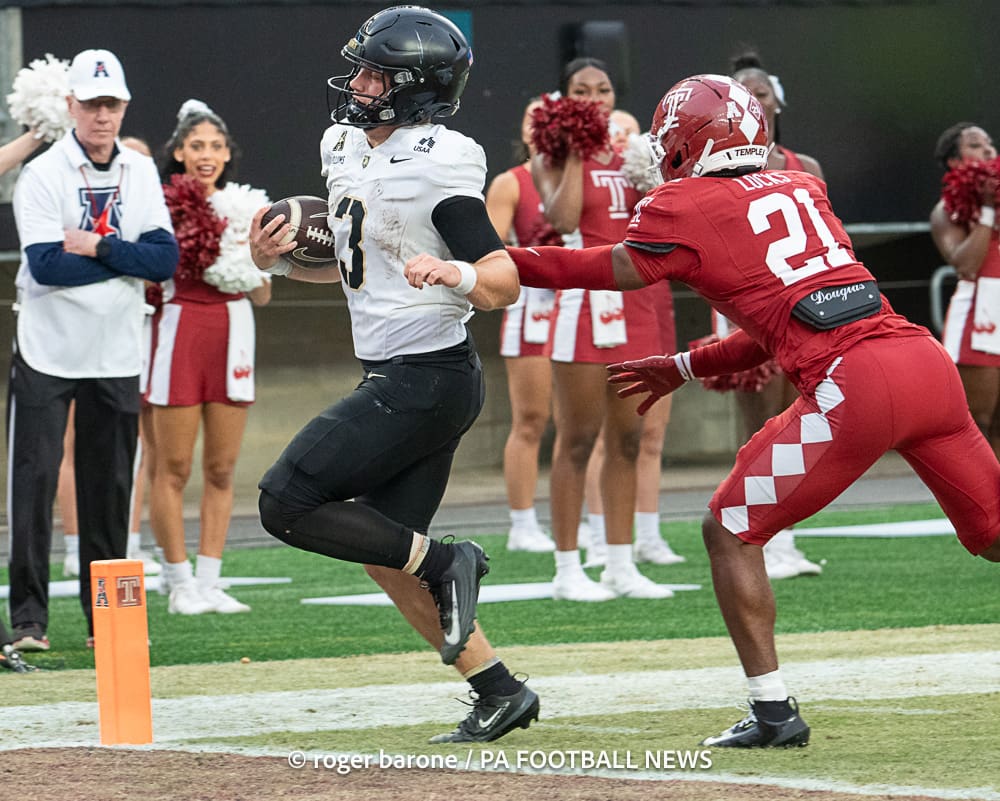
THE X’S AND O’S BREAKDOWN: Temple must stretch UConn’s defense and contain Kalieb Osborne
Tagged under: Pennsylvania Colleges, pfn, Temple
Mike Livingston | October 8, 2026
Temple has spent the first five games establishing what it does best.
The Owls run the ball. They have surpassed 175 rushing yards in every game and enter Saturday averaging 212.6 per contest. Defensively, Temple has increasingly forced opponents to sustain drives rather than surrendering touchdowns through the air.
Against UConn, both identities will be tested.
The Huskies present Temple with an unusual matchup: a defense that has been strong against the run but vulnerable through the air, paired with an offense capable of creating explosive plays with quarterback Kalieb Osborne and running back Cyncir Bowers.
Temple offense vs. UConn defense: Make the Huskies defend the whole field
Temple’s rushing attack has been its most dependable offensive element, but simply leaning harder into that strength may not be the most effective approach Saturday.
UConn has allowed only 110.8 rushing yards per game through five weeks. The Huskies have held two opponents below 100 yards and entered the week ranked 35th nationally in rushing defense.
The passing defense has produced almost the opposite result.
Opponents have averaged 290.8 passing yards against UConn. Maryland completed 35 passes for 350 yards, while Syracuse threw for 318 last week.
That means Temple cannot allow UConn to dictate the terms of the game by continually running into loaded boxes.
Ajani Sheppard does not need to become a 40-attempt quarterback, but the Owls should give him opportunities to throw on early downs before the defense knows what is coming. Quick completions, play-action, and shots to Colin Chase and Jayce Freeman could force UConn’s linebackers and safeties to respect more than Temple’s backfield.
That would also benefit the run game later.
If Temple can make UConn defend the entire width and depth of the field, Keveun Mason and the Owls’ offensive line should eventually see lighter numbers around the line of scrimmage.
UConn linebacker K’Von Sherman is the player Temple must account for most consistently. Sherman is tied for the team lead with 34 tackles and leads the Huskies with 6.5 tackles for loss, three sacks and three forced fumbles.
Keeping him from wrecking early downs will be important to maintaining offensive balance.
Temple defense vs. UConn offense: Build a cage around Osborne
UConn’s offense becomes difficult to defend because Osborne can punish defenses in two different ways.
He has thrown for 1,164 yards and 10 touchdowns while adding 243 yards and five scores on the ground. Bowers has provided another explosive rushing threat, averaging 7.4 yards per carry with 349 yards and five touchdowns.
Temple therefore cannot approach its pass rush as simply getting to a spot behind the offensive tackles.
The Owls need to pressure Osborne while keeping him inside the pocket.
If edge rushers fly too far upfield, Osborne can escape underneath them. If Temple collapses too aggressively inside, it risks opening lanes outside. The objective should be to create a pocket that becomes progressively smaller rather than immediately breaking contain in pursuit of a sack.
That is especially important because UConn has already shown how dangerous a single missed assignment can become. Bowers’ 71-yard touchdown against Syracuse helped erase a 20-point deficit, while Osborne has already produced five rushing scores himself.
Temple has only four sacks through five games, so suddenly becoming an overwhelming pass-rushing team is probably unrealistic. The more important goal is making Osborne uncomfortable without allowing the pressure itself to create running lanes.
Behind that rush, Temple’s secondary will also have to defend a deep group of receivers. UConn has four players with at least 160 receiving yards, led by Javon Brown’s 202. Shamar Porter is averaging 21.8 yards per catch.
That forces Temple to balance containing Osborne with preventing explosive throws when he extends plays.
The matchup that could decide it: Early downs
Saturday could turn on what happens before third down.
If Temple’s offense consistently faces second-and-5 instead of second-and-10, its entire playbook remains available. If the Owls repeatedly run into UConn’s strength and fall behind schedule, the Huskies can attack Sheppard in predictable passing situations.
The same principle applies defensively.
Allowing Bowers or Osborne to consistently gain five or six yards on first down would give UConn too many options. Temple needs to win enough early downs to force Osborne into situations where the defense knows a pass is more likely.
That is when defensive coordinator Brian Smith can become more aggressive.
Bottom line
Temple should not abandon the identity that has carried its offense through five games, but UConn is the opponent that most clearly demands greater balance.
The Owls need Sheppard to make the Huskies respect the passing game, creating room for their rushing attack as the game progresses.
Defensively, everything revolves around Osborne. Temple does not necessarily need to sack him repeatedly. It needs to prevent him from turning pressure, broken plays, and missed assignments into explosives.
If the Owls accomplish both, they can force UConn to play the game on Temple’s terms rather than its own.